A tailoring management system for two shops and more
A tailoring management system is judged by one question: can you see every branch at once, then drop into one of them, without entering anything twice? This page is for the owner of a second shop, or a workshop that outgrew a single notebook.
No credit card · set up in under 10 minutes
- ZATCA phase two compliant
- Unlimited orders & customers
- Runs in the browser — nothing to install
FROM INSIDE THE SYSTEM

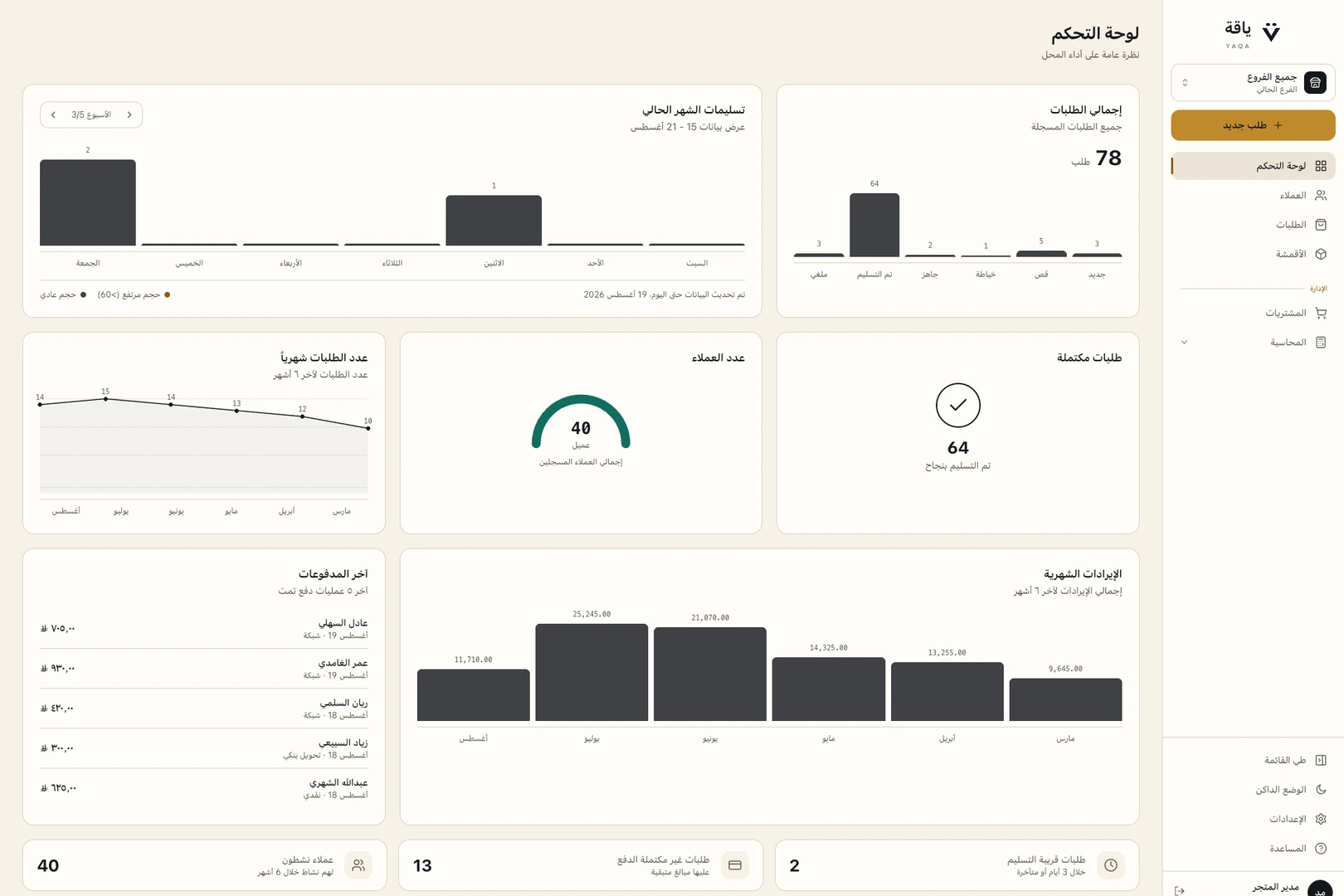

AT A GLANCE
- Scope
- A tailoring management system for owners of branches and workshops
- Branches
- Stock, a till and reports per branch, with one consolidated view — on the advanced plan
- Staff
- An account per employee with its own permissions; one on basic, unlimited on advanced
- Stock
- Every fabric in metres per branch, drawn down automatically at cutting, with a movement log
- Reports
- Income statement, trial balance and a VAT return — on the advanced plan
- Invoice numbering
- One ZATCA-compliant sequence that neither repeats nor breaks across branches
The second shop is what breaks the old method
One shop runs on memory and a notebook. A second one does not. Three questions appear that did not exist before: which branch has the fabric this customer is asking for, which staff may see the numbers and which may not, and what the two branches earned together rather than each on its own. That is where «software for a shop» ends and a tailoring management system begins.
The difference is not a longer feature list. It is that data is entered once and read from two angles: the branch that is doing the work, and you looking at all of them. Any system that makes you enter the order in one place and the money in another is not a management system — it is two electronic notebooks.
Branches: all of them at once, then one of them
You add your branches by name, and each one has its own orders, customers, fabric stock and till. At the top of the screen sits a branch switcher: pick «all branches» and you see the whole picture — every open garment, the late ones, total revenue — or pick one branch and everything narrows to it, reports included.
This matters more than it looks. An owner who sees both branches together notices that one runs late on delivery and the other does not, and that fabric sitting idle in one is wanted in the other. Someone running two shops from two notebooks never sees this, because the comparison itself is not possible.
Staff and permissions: who sees the numbers
A tailor needs to see the garment, its measurements and its stage; he does not need to see the month's profit. A cashier needs to take payment and print an invoice; he does not need to change prices. So each employee gets an account with their own permissions, and every action is recorded against whoever performed it: who moved the stage, who took the payment, who edited a measurement.
That log is not surveillance. It is what settles the argument when a customer says he paid 300 riyals and nobody remembers. The basic plan includes one staff account and the advanced plan unlimited ones — the detail is on the pricing page.
Fabric stock per branch, and its movement
Fabric is the largest amount of money standing still in a tailoring shop, and the thing most likely to disappear unnoticed. Every fabric has a code, a name, a price per metre and a balance per branch. When a garment is cut, the metres come off the balance of the branch that cut it, not off a shared pool.
Every movement leaves a line saying where the stock went, when, and against which order — so when a count comes up short, you can find it instead of guessing. Supplier purchase invoices go in with their metres and cost, and yards convert to metres on receipt so nothing is counted in two units. Barcode labels print for the fabrics, and a stock report prints to carry with you while counting.
Reports: is the branch profitable or merely busy?
A busy branch is not necessarily a profitable one. So for any period you choose, and for one branch or all of them, you get an income statement with revenue, expenses and net profit, a detailed account statement per line, a trial balance, journal entries, and a VAT return ready to file. All of it prints or exports.
One thing worth stating: these reports compute over the whole period, not over whatever fits on screen. A total that sums a single page of a list is a wrong number rather than a cosmetic flaw, so every figure is calculated against all the data.
E-invoicing across the whole business
There is one VAT number for the business, and the sequential invoice numbering neither breaks nor repeats across branches — which is exactly what catches out owners who run separate software per branch. The simplified invoice is in Arabic, with the VAT breakdown and a place for the QR code, and a copy of every invoice issued is retained.
Does it work offline?
No, and being a web app we will not claim otherwise. In the branch context that is closer to a feature: the data lives in one place rather than on each branch's machine, so there is no «eastern branch file» waiting for somebody to merge it, and no version newer than another. The printed documents — invoice, measurement sheet, receipt, stock report — stay in the workshop's hands if the connection drops.
Migrating two or three branches
Moving several branches is not harder than moving one shop; it just has to be done in a particular order:
- The branches first, by name, because everything after that hangs off a branch.
- Then fabrics and their current balance per branch — this deserves a proper day of counting, because a wrong opening balance stays wrong.
- Then customers and their measurements, from one file for all branches; a customer belongs to the business, not to a branch.
- Then open orders only. Do not load a year of history — load what has not been delivered yet.
We walk through the first migration with you and check that the numbers landed correctly.
Three mistakes that recur when the second shop opens
These are not theories — they are what we see in an owner's first two months with a new branch:
- Separate software per branch. It looks easier, and it breaks sequential invoice numbering while putting one VAT number on two series. Then a stock count or a VAT return arrives and the figures have to be merged by hand — which is precisely what is not acceptable from a VAT-registered business.
- One fabric pool for both shops. The balance becomes a number that describes neither branch: the one cutting draws down a shared figure, so you believe you have twenty metres when they are a city away. Balance per branch, and a transfer between them recorded as a movement.
- One login everybody shares. The easiest thing on day one and the most expensive at the first dispute: you cannot tell who took payment, who changed a price, who moved a stage. An account per employee is not complexity — it is what makes the log mean anything.
And if it is only one shop?
Then you do not need half of this page today. Start with what happens at the counter — tailor shop software — and branches and permissions will be waiting in the same account when you need them, with no migration and no new system. The remaining questions are on the FAQ.
Prices and both plans are on the pricing page, and the rest of the questions on the FAQ.
FOR EVERY SIZE OF SHOP
From a single tailor to a multi-branch workshop
Small shop
One branch today? Start on the basic plan — branches wait in the same account, with no migration.
Mid-size shop
Two branches: fabric balance and a till per branch, and one invoice sequence that never breaks between them.
Large workshop
A workshop with several branches and tailors: permissions per employee, consolidated reports, and an income statement per branch and for all together.